
The Remediation Bill: what owners must do before it becomes law
By the HAALO team · November 2026
Why the Remediation Bill, and why now
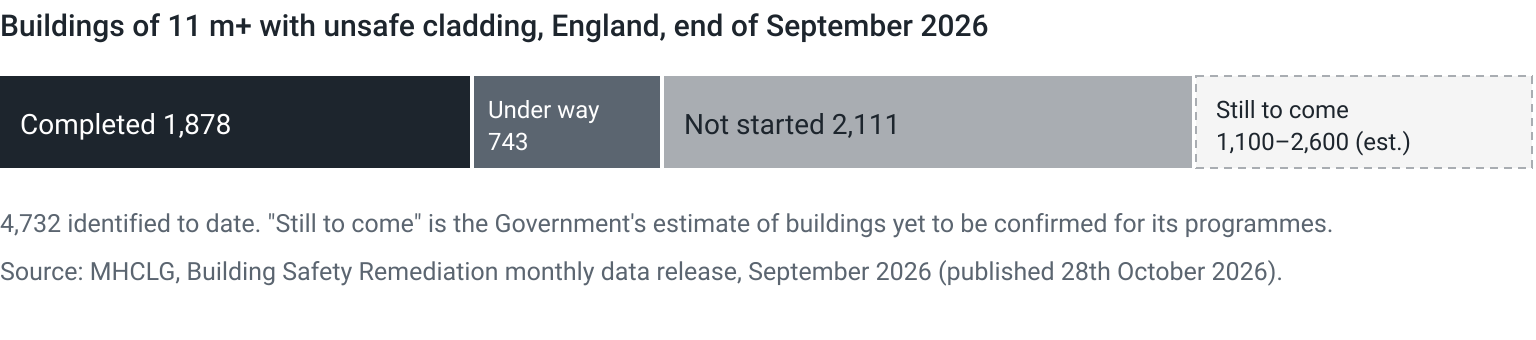
Nine years after Grenfell, almost half the buildings identified with unsafe cladding have not started remediation: 2,111 of 4,732 at the end of September 2026. Funding schemes and the Building Safety Act 2022 protected most leaseholders from the cost, but placed no general duty on anyone to get on with the work. Action has come through funding applications or tribunal orders, one building at a time. In December 2024, the Government's Remediation Acceleration Plan promised a legal duty, with penalties, on those responsible for buildings of 11 metres and over. The Remediation Bill, introduced on 14th October 2026, delivers it.
HAALO's view: remediation will be judged on evidence
Under the Bill, remediation also becomes a question of who is responsible, and what they can prove. The responsible entity will have to show what it assessed, what it decided and why, on a dated record.
HAALO's view: owners who start that record now will be better placed to show what they did, and why, when the Bill becomes law.
What's at stake for owners and investors
For an owner, the risk is no longer only the cost of the works. The risk is potential fines, criminal prosecution and, in the worst case, a local authority or Homes England (the Government agency that runs the cladding funding schemes) taking over the building and recovering its costs as a charge on the property, which can carry a power of sale. Investors should consider what this means for the value of the asset and the companies that hold it.
Who is the responsible entity?
The Bill places a legal duty on the "responsible entity", defined in the Bill as whoever must repair or maintain the building's external walls, under a lease or by law. Depending on the lease structure, that can be the freeholder, a head or sub-lessee, a right to manage company or a resident management company. In practice it is often a single company within a wider group, such as a subsidiary or special purpose vehicle, which is why the Bill reaches the group above it. The duty covers residential buildings in England over 11 metres or five storeys, completed before 28th June 2022. Where works are needed, a Remediation Compliance Plan must be published on the responsible entity's website. For a company, it names the director responsible, and it is shared with residents and leaseholders. Deliberate failure to remediate can mean prosecution, with up to two years in prison, or a penalty of up to £500,000, and directors can be prosecuted personally where a breach results from their consent, connivance or neglect. For a building worth millions, the fine is the smallest part of it. The real cost is losing control of the works, and what that does to the asset.
What counts as evidence: PAS 9980 and the reasonable excuse defence
Where a fire risk assessment of external walls (FRAEW) is required, it must follow PAS 9980, and Homes England will audit it. As we said in our PAS 9980 paper, an FRAEW is important evidence, but on its own it is not proof that a relevant defect has been resolved. The Bill's "reasonable excuse" defence covers good-faith delay, such as contractor shortages, but only where the effort can be shown: a dated record of what was decided, when and why.
When does the duty to assess start?
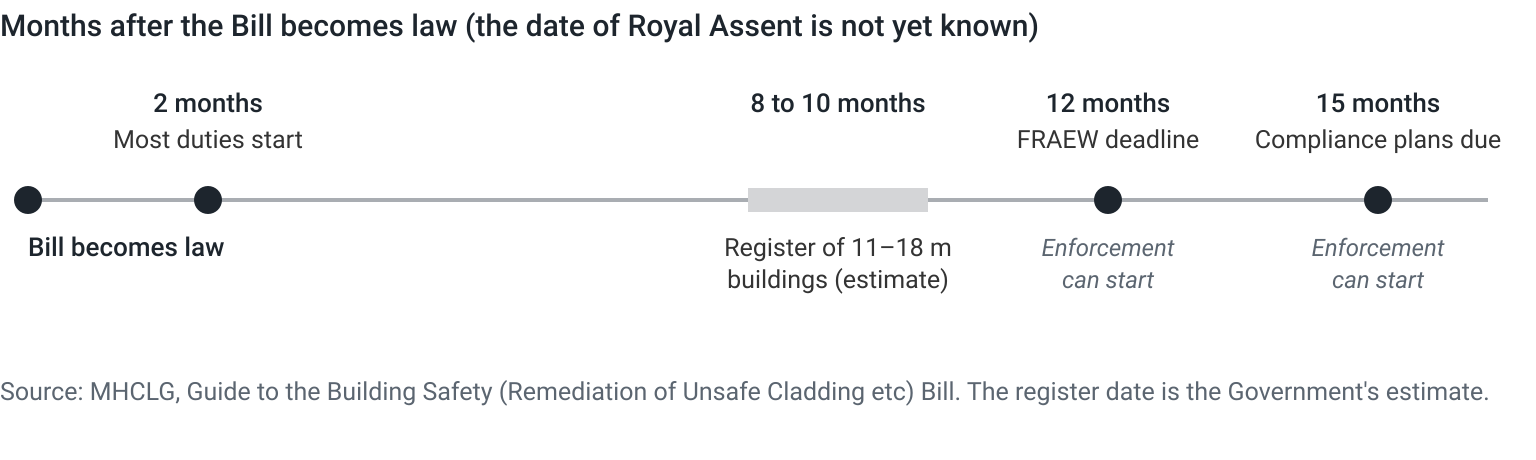
Most duties start two months after Royal Assent. An FRAEW, where one is needed, is due within 12 months, and the compliance plan within 15, and regulators can take enforcement action from each of those deadlines. The Government also expects a register of buildings of 11 to 18 metres about 8 to 10 months after Royal Assent. There is no date for Royal Assent yet; it is expected in the first half of 2027.
The Government estimates a further 1,100 to 2,600 buildings are still to be confirmed for its programmes, and the Bill's duty to assess, which requires each responsible entity to have its building's external walls assessed (the FRAEW above), is designed to find them. Even the developers who signed up to fix their own buildings are behind: the Government's target, as reported by Construction News (29th October), was works started or completed on 80% of them by July 2026, yet MHCLG's figures, reported by the developers, show 1,266 of 2,682 had not started at the end of July. Developers point in part to delays in Building Safety Regulator approvals (Construction News, 6th November). With this many buildings still to start, HAALO expects owners to be competing for the same assessors and contractors, to the same deadlines.
What the Remediation Bill means for owners, investors and boards
Owners and portfolio holders. The duty follows the repairing obligation, not ownership on paper. It can sit with a freeholder, a head or sub-lessee, a right to manage company or a resident management company; buildings under the Developer Remediation Contract are excluded.
Investors and funders. The plan, and the director's name on it, will be public. For any asset or portfolio, ask: who holds the duty, would the FRAEW stand up to audit, and which director owns the plan?
Boards. A named director means named exposure. The board should know who that director is, and what record stands behind them.
What we don't know yet
The Bill passed its second reading on 27th October and goes into committee stage from 12th November, where it will change. The Government has said amendments will follow, including a scheme to recover costs from manufacturers of unsafe cladding and insulation, and wider protections for leaseholders. Regulations will set out the remediation steps, and every deadline runs from a Royal Assent date nobody knows. We will update this paper as the Bill progresses.
What owners should do now
Start now, before Royal Assent. Each of these steps builds the record the Bill will ask for.
Find out where the duty sits. For each building over 11 metres, establish which entity holds the repairing obligation and which group sits above it. Where HAALO comes in: Portfolio Shielding maps this across a portfolio.
Know what assessment you hold. Check that each building's fire risk assessment (FRA) is valid and up to date, whether it covers the external walls, and whether it calls for an FRAEW. Then check whether each building has an FRAEW, when it was done, and whether it follows PAS 9980. Where HAALO comes in: Asset Defensibility tests whether FRAEWs and records would stand up to a Homes England audit.
Name the director. Decide who will own the Remediation Compliance Plan, and make sure the board knows. Where HAALO comes in: Portfolio Shielding maps which company holds the duty for each building, and where the group above it is exposed.
Start the dated record today. Record decisions, progress and any reason for delay. The "reasonable excuse" defence will rest on it. Where HAALO comes in: Asset Defensibility finds the gaps before investors, lenders or regulators do.
Portfolio Shielding Review. HAALO maps the exposure across your portfolio, tests the historical records and shows exactly where risk sits, before legacy issues harden into regulatory failures and liabilities. Under the Remediation Bill, that means knowing which company holds the duty for each building, what evidence stands behind it, and what needs to happen first. The outcome: every liability identified, prioritised and evidenced, before it reaches the balance sheet or a regulator's attention. Request a Portfolio Shielding Review.
Related papers: PAS 9980:2026: what it is, and what it isn’t · Can you prove your fire-stopping?
This paper sets out HAALO's professional perspective on this matter at the time of drafting. It is meant to be general information, not advice or legal or financial opinion on any specific building. The content of this paper should not be relied upon and we always recommend the reader retains their own professional advisory team. The Bill may change before Royal Assent.
Sources
- MHCLG, Remediation Acceleration Plan (2nd December 2024)
- MHCLG, Guide to the Building Safety (Remediation of Unsafe Cladding etc) Bill
- MHCLG, Building Safety Remediation monthly data release, September 2026 (published 28th October 2026)
- MHCLG, More people protected as government acts to make more homes safe (27th October 2026)
- DAC Beachcroft (21st October 2026)
- UK Parliament, Building Safety (Remediation of Unsafe Cladding etc) Bill, stages
- Construction News, Almost half of buildings under developer contract still await repairs (29th October 2026)
- Gowling WLG, Remediation Bill watch: new duties, tougher enforcement and greater accountability (2026)
- Burges Salmon, Building Safety Remediation Bill: what property developers need to know (20th October 2026)
- HAALO, PAS 9980:2026 insight paper


